
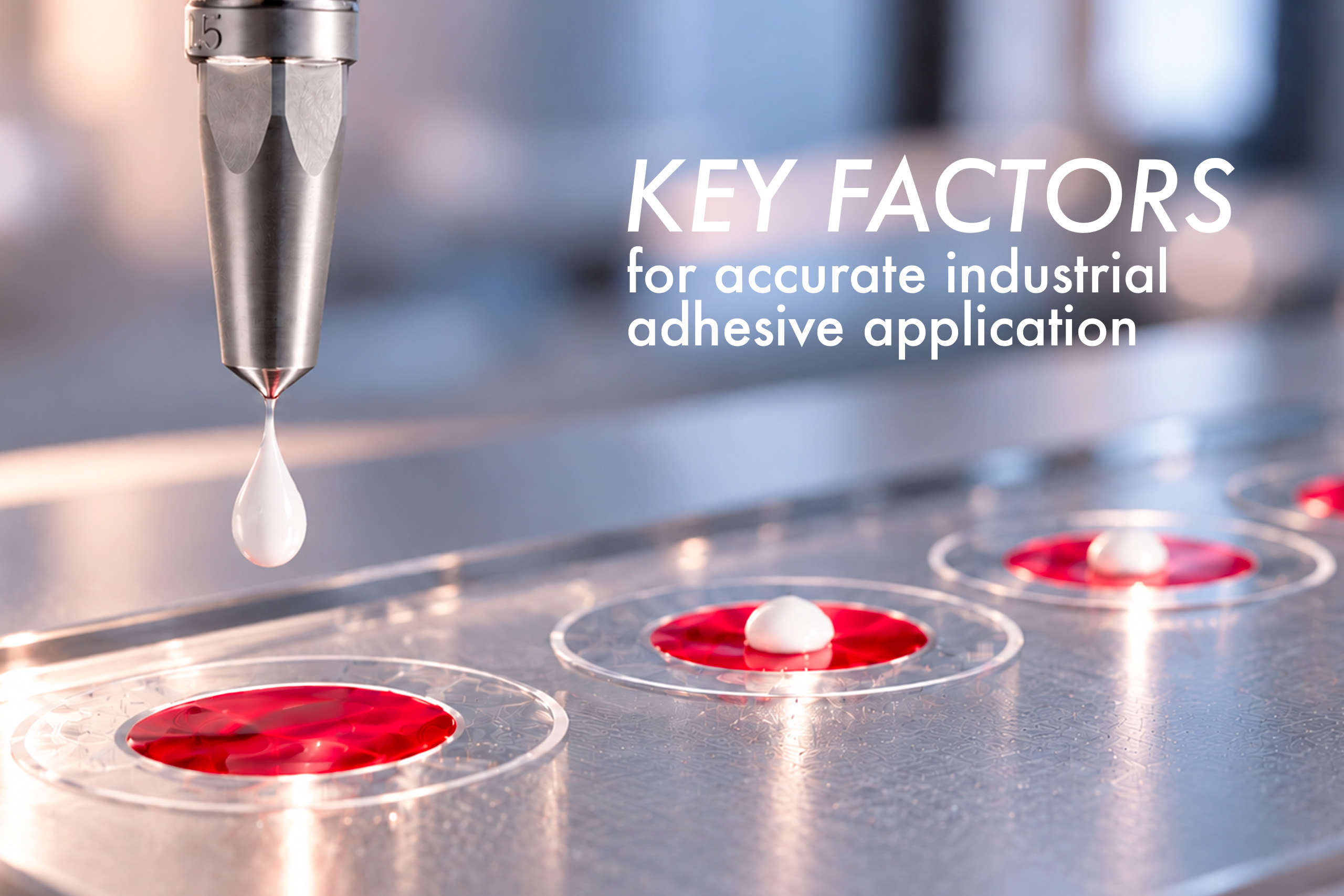
Industrial adhesive application
Key factors BY Zator
In industrial adhesive application, the result does not depend on a single component. It comes from the interaction between the fluid, the dispensing system, the machine and the production conditions.
From paper converting and packaging to woodworking, every process has different characteristics and requires a specific configuration.
Five factors, one custom solution
Fluid characteristics, type of application, production requirements, reliability and result repeatability must be considered together to configure the most suitable dispensing system for each process.
Let us take a closer look at these five factors.
1. The fluid
Every fluid has specific characteristics that determine how it behaves within the system.
Viscosity, composition, operating temperature, the possible presence of solid particles and sensitivity to air or moisture can influence the choice of the feeding system, valve, nozzle and dispensing parameters.
Changes in formulation or operating conditions can also alter product behaviour. It is therefore important to start by understanding the fluid and checking its compatibility with every component of the system.
In folder-gluer systems, for example, a low-viscosity adhesive may be handled with a low-pressure system, whereas a more viscous product may require a piston pump and higher feeding pressures.
The correct system configuration therefore always starts with the characteristics of the product to be applied.
2. THE TYPE OF APPLICATION
Dots, beads, continuous lines, intermittent patterns or spray applications: every process requires a specific dispensing method.
The selected technology must take into account the shape and quantity of the deposit, the substrate, the dispensing distance and whether the application is contact or non-contact.
In woodworking and furniture component assembly, for example, adhesive may be applied in dots or beads, or atomized through spray valves.
When the application geometry or method changes, the most suitable technical solution changes as well. The valve, nozzle and feeding system must therefore be configured according to the required result.
3. Production requirements
Line speed, application frequency, required quantity, valve opening times and machine integration are essential elements in defining the system.
Industrial lines do not always operate at a constant speed. When speed changes, the application system must adjust dispensing to maintain the correct amount of adhesive and preserve the required application geometry.
Pressure and flow rate must be controlled according to the process. If line speed increases, the flow rate may need to be adjusted while pressure remains stable and controlled.
Sensors, encoders and control systems make it possible to synchronize dispensing with the machine cycle and manage adhesive dots and beads in the required position.
The system must therefore be sized not only according to the fluid, but also according to the actual production conditions.
4. Reliability
In an industrial process, correct application must be maintained throughout the entire production cycle.
Reliability depends on component quality, correct system configuration, compatibility with the fluid and the ability to operate under the required conditions without interruptions or unwanted variations.
Ease of adjustment, cleaning and maintenance also contributes to process continuity and reduced machine downtime.
For this reason, every component, from the feeding unit to the valve and nozzle, must be selected as part of one complete system.
5. Result repeatability
A precise application must not be achieved only once: it must be repeatable over time and under different operating conditions.
The dispensed quantity, deposit position and application geometry must remain consistent from one production cycle to the next.
Repeatability depends on coordinated control of the fluid, pressure, flow rate, line speed and valve opening times.
Integration with the PLC, sensors and machine controls enables the system to adapt to the process and keep the result within the defined parameters.
From individual variables to a complete system
The five factors must not be considered separately. The fluid influences the feeding and dispensing technology; the type of application determines the valve and nozzle selection; production requirements define speed, flow rate and control methods.
Reliability and repeatability are the result of correctly coordinating all these elements.
This system-wide approach is where Zator adds value.
We design and manufacture systems for applying adhesives and fluids in-house, integrating feeding units, controls, valves, sensors and components according to each customer’s specific requirements.
We do not offer standard products alone: we configure every system according to the fluid, the application, the machine characteristics and the production objectives.
Tell us about your application: we can help you identify and configure the most suitable dispensing system for your process. Contact us.
Subscribe to the channel to stay up to date on all the latest news!
Why choose zator
Choosing Zator means relying on an expert partner in gluing and fluid management solutions, designed to ensure reliability, precision, and operational continuity. Our valves and gluing systems are engineered to integrate seamlessly into production processes, even in the most complex industrial environments.
We design and manufacture every component in-house, offering customized, tailor-made solutions developed according to strict Made in Italy standards. Every product is tested and verified before installation, because for us quality is a concrete, daily commitment.
